








Paint unit price ≠ actual cost
Don't be misled by low-priced paint!
Many factories and properties prioritize price when purchasing road marking paint. They believe buying cheaper paint will save money, but after actual use, they discover that the markings fade and peel quickly, requiring repeated rework and repainting, ultimately resulting in higher overall costs. Today, let's discuss the often-overlooked hidden costs in road marking procurement.
I. Four major hidden problems with low-priced paints
PART.01
Poor paint film density and weak water and weather resistance
Some sub-sectors are lagging behind schedule and still fall short of targets; market responsiveness is insufficient, low-priced coatings have low resin content, resulting in loose and porous paint films. They easily absorb water and swell in rainy weather or on wet surfaces, peeling and flaking quickly, especially in damp garages and low-lying areas. What may seem like a cheap purchase may require rework within just a few months. Contingency plans for unforeseen circumstances are inadequate.
PART.02
Insufficient pigment content results in a short color development period.
To reduce costs and minimize the use of pigments, the colors were initially bright, but quickly faded and turned gray after being driven over by vehicles and exposed to sun and rain. This reduced the visibility of the road markings, creating traffic safety hazards, necessitating premature renovation.
PART.03
Insufficient adhesion makes it very easy for the entire piece to fall off.
Inferior raw materials and additives result in poor adhesion between the paint and the ground. After being rolled over by tires or subjected to alternating hot and cold temperatures, the paint peels off in patches and curls. Removing the old markings later requires additional labor and equipment, adding an extra hidden expense.
PART.04
Poor construction performance, waste of materials and labor time
Some low-priced paints require dilution with solvents, and the mixing ratio depends entirely on experience, which can easily result in an excessively thin paint film. This leads to a low coverage rate, meaning the same weight of paint covers a smaller area; slow drying speeds also increase the time required to close the work area, indirectly increasing management costs.
II. How to choose the one that truly offers high cost-performance?
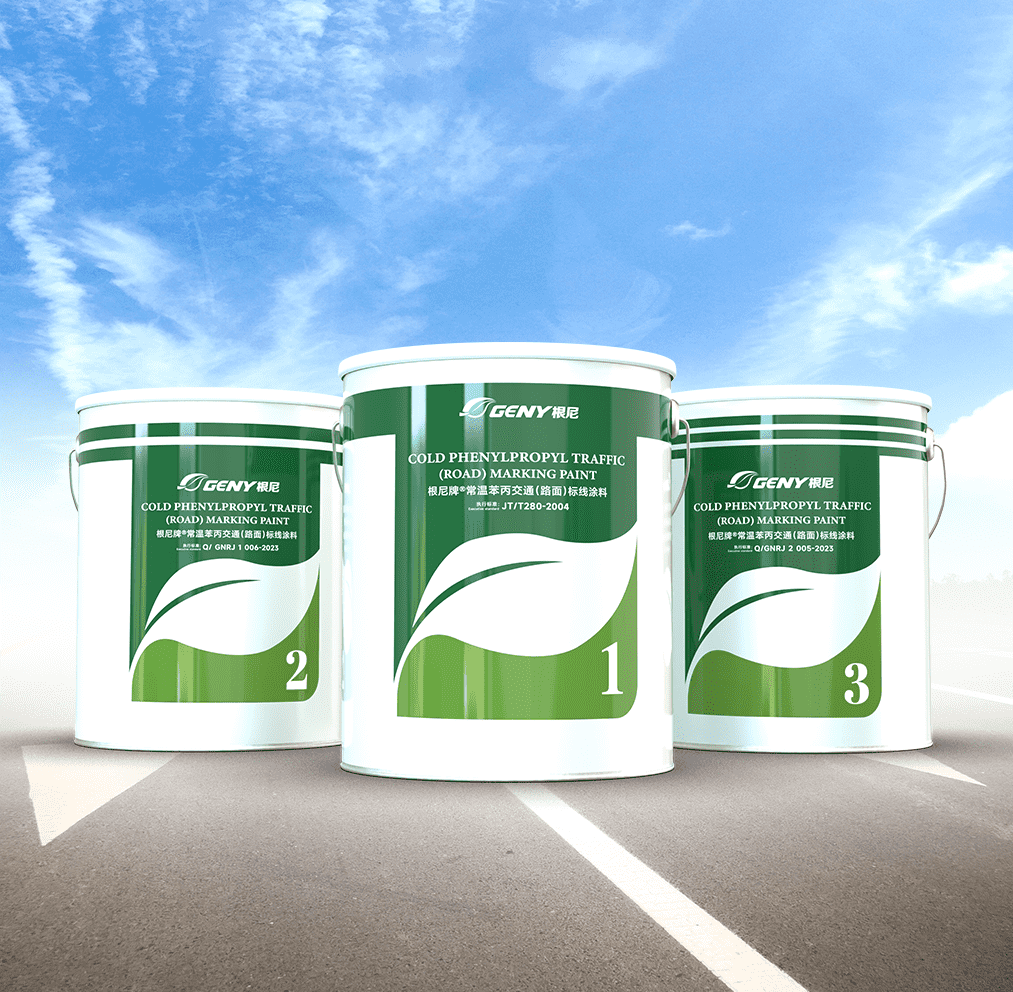
For the renovation of markings in factory areas, parking lots, and underground garages, prioritize using GENY acrylic normal temperature marking paint.
01 Dense and water-resistant
High-quality styrene-acrylic resin produces a dense, water-resistant coating that is not prone to whitening or delamination and can be used stably even in humid environments.
02. Long-lasting color rendering
High-content weather-resistant pigment, high saturation of yellow and white color, not easy to fade or chalk with long-term use, and longer visual period of marking lines;
03. Firm adhesion
High adhesion, firmly adheres to cement and asphalt surfaces, resists rolling and tearing, and reduces the probability of peeling, curling, and rework.
04 High-efficiency construction
It can be applied directly after opening the can without the need for additional solvent dilution; it has excellent coverage, allowing for the application of a larger area with the same weight of paint; it dries quickly in 15 minutes, reducing the time required for site closure; and it is flameless when applied cold, making it safe for construction in enclosed spaces.
Science popularization summary
When assessing the cost of lane marking paint, one cannot simply look at the price per can; one must also consider hidden costs such as service life, rework labor, and material waste. Choosing reputable, high-quality, room-temperature lane marking paint reduces the need for repeated rework and truly helps save on overall project costs.
