









In the road traffic engineering industry, peeling, cracking and chipping of hot-melt markings on cement concrete pavement (CCP) have long been a persistent challenge for constructors and project owners. While hot-melt markings deliver stable performance on asphalt pavement, they often degrade within months of service on cement surfaces — even if they pass on-site acceptance inspection. Repeated touch-ups not only drive up overall project costs, but also compromise road safety and traffic efficiency.
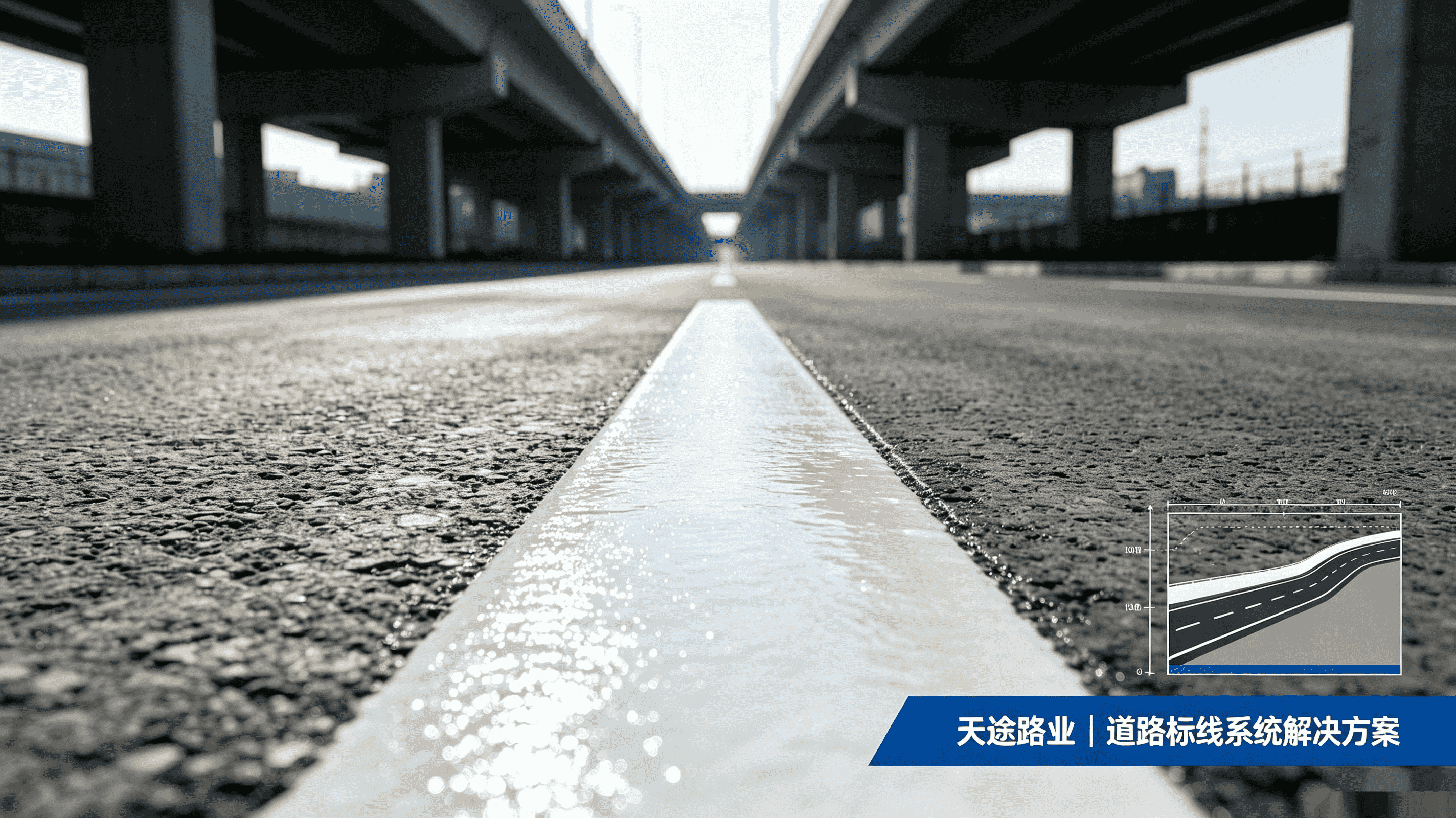
As a global full-industry-chain provider of road marking solutions, TATU Highway Group draws on over 30 years of industry expertise and extensive engineering practice. We hold that frequent chipping of hot-melt markings on cement pavement rarely stems from a single construction error. The real root cause is insufficient system matching among marking materials, base pavement and service environment. To solve the durability problem fundamentally, we must move beyond the "blame construction" mindset and optimize solutions from a systematic perspective.
I. Don’t Be Misled by Appearances: Chipping Is Not Always a Construction Fault
When marking failure occurs on site, it is commonly attributed to "insufficient primer", "poor surface cleaning" or "uncontrolled application temperature". While construction quality does affect performance, repeated identical issues on cement pavement projects call for a deeper look at the underlying logic.
Hot-melt markings are a polymer-based material system, while cement concrete is a rigid inorganic material. The interfacial bond between the two is far from a simple "coat-and-stick" process. The current Technical Specification for Construction of Highway Traffic Safety Facilities explicitly mandates primer application prior to hot-melt marking installation. This confirms a key point: marking engineering is a systematic project jointly determined by base surface, primer, coating and construction conditions. Fixing one single step cannot resolve material incompatibility at the source.
II. Three Underlying Causes That Limit Marking Durability on Cement Pavement
1. Higher adhesion requirements from cement base layers
Cement concrete pavement features high strength and high rigidity, with surface porosity and adhesion properties fundamentally different from asphalt pavement. It imposes much higher demands on the interfacial penetration and bonding strength of marking coatings. Ordinary hot-melt coatings, applied directly based on asphalt pavement experience, often fail to form a stable, long-lasting bond.
2. Cumulative stress from mismatched thermal expansion
Both pavement and markings expand and contract with temperature changes, but the two materials have different thermal expansion coefficients. Under repeated cycles of day-night and seasonal temperature shifts, the marking-base interface sustains continuous shear and tensile stress. If the coating lacks low-temperature flexibility or has weak interfacial adhesion, microcracks will gradually spread, eventually leading to edge lifting, flaking, or full delamination — the "chipping" seen on site.
3. Short-term acceptance ≠ long-term durability
At the acceptance stage, visual metrics such as color, line shape, thickness and retroreflectivity are easy to satisfy. But road markings face real, long-term stresses in service: repeated tire loading, rain infiltration, high-temperature softening, low-temperature embrittlement, minor pavement deformation, and surface pollutant erosion. All these factors gradually erode marking performance over time.
For this reason, the current standard GB/T 16311-2024 Road Traffic Markings — Quality Requirements and Test Methods explicitly classifies "cracking and peeling" as unacceptable defects in marking coatings. Marking durability has become a core measure of engineering quality.
III. TATU Solutions: Two Technical Pathways for Different Project Needs
Targeting the complex service conditions of cement pavement markings, TATU Highway Group leverages its full-industry-chain R&D and engineering capabilities to deliver two proven technical solutions. Both balance constructability and long-term durability, helping projects achieve optimal life-cycle cost.
Path 1: Premium long-term option — Two-component marking system
For highways, urban arterial roads, heavy-traffic corridors, and projects sensitive to service life and maintenance cost, we recommend the two-component marking system as the first choice.
Unlike traditional hot-melt materials that form films via physical cooling, Tatu Highway Coatings two-component markings form a cured cross-linked structure through chemical reaction. The formula can be tailored for cement pavement scenarios to optimize adhesion, crack resistance, abrasion resistance and weatherability, greatly boosting long-term stability on cement bases.
From a life-cycle perspective, two-component markings have a slightly higher upfront material cost, but they significantly reduce maintenance frequency, traffic management costs and rework risks. The overall economic benefit is superior, making them ideal for heavy-traffic cement pavement applications.
Path 2: Optimized hot-melt solution — Cement-specific coatings + matched primer + standardized construction
When projects require hot-melt technology due to budget constraints, design specifications or construction practices, TATU provides a complete enhanced package: cement-adapted hot-melt coatings + application-specific primer + standardized construction control — to overcome the compatibility limits of standard hot-melt materials.
· Material adaptation: Formula optimized for cement substrates, with improved low-temperature flexibility, interfacial adhesion and crack resistance to match the rigidity and thermal behavior of cement pavement.
· Interface reinforcement: Matched specialty primer improves base surface condition and creates a robust transition layer between coating and pavement, boosting bonding reliability.
· Construction standardization: Full-process technical guidance — from laitance, dust and oil removal to application temperature and film thickness control — to ensure consistent, quality execution.
IV. Proactive Risk Control: Test Sections Prevent Large-Scale Rework
Most marking problems do not have to wait until full project completion to surface. TATU Highway Group recommends installing small test sections before large-scale construction. These test sections allow side-by-side validation of different materials, primers and construction parameters, with comprehensive evaluation of appearance, adhesion, thickness, retroreflectivity and early durability.
This approach locks in the optimal solution upfront with minimal test work, avoiding the cost and schedule risks of full-project rework — a key strategy for cost efficiency in road marking engineering.
V. Professional Marking Solutions Go Beyond Selling Materials
The quality of a road marking project is never determined by a single product. It results from the combined performance of base condition + material system + primer + construction equipment + application parameters + environment + post-maintenance.
As the world’s exclusive full-industry-chain road marking provider, TATU Highway Group focuses on three core business segments: road special equipment, road special materials and road special services. Our five major brands include Tatu Highway Coatings, WELL-ROAD (NANTONG WELL-ROAD SPECIAL VEHICLE CO., LTD.), GENY (Shanghai GENY Traffic Safety Facilities Co., Ltd), TRAFFIC MARKING MARKETPLACE and SPECIAL VEHICLE RENTAL. With 5 production bases across China (Nantong, Cangzhou, Chengdu, Zhengzhou, Guangzhou), our products and services reach over 100 countries and regions worldwide.
We move beyond the traditional "material-only" sales model to deliver integrated solutions combining materials + equipment + construction technology + after-sales support. From scheme design and product selection to on-site guidance and technical training, we ensure the long-term durability of cement pavement marking projects across the entire value chain.
If you are facing durability challenges with cement pavement markings, or would like to learn more about systematic road marking solutions, please contact us. TATU Highway Group will leverage its full-industry-chain capabilities to deliver a tailored solution for your project.
