








Road traffic safety is of paramount importance in workplace safety, affecting countless households and impacting people's well-being. Road traffic signs and markings are crucial facilities for conveying standardized information and guiding traffic flow, playing a vital role in improving road capacity and traffic conditions.
Road traffic signs and markings are installed on urban roads and highways, working alongside traffic lights and other facilities to inform road users of their right-of-way, clearly indicating prohibitions, restrictions, and compliance requirements, and displaying road and traffic conditions. Through their shapes, colors, patterns, and text, traffic signs and markings form a traffic language, providing information and communication to all road users, thereby enabling them to use the roads in an orderly manner, promoting road traffic safety, and improving road operational efficiency.
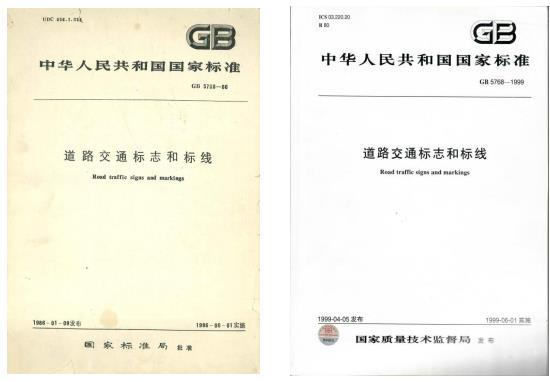
The Birth and Evolution of the National Standard "Road Traffic Signs and Markings"
To standardize the use of road traffic signs and markings, my country promulgated the national standard "Road Traffic Signs and Markings" (GB 5768-1986) on January 9, 1986. This standard actively adopted international standards, aligning itself with international practices and promoting international unification. "Road Traffic Signs and Markings" supplemented and improved upon the ministerial standard, specifying the content of traffic signs and markings in terms of graphics, symbols, and text. The standard divided traffic signs into two main categories and five parts, totaling 168 types. This standard came into effect on August 1, 1986.
With the rapid development of the social economy and the acceleration of urbanization, road infrastructure construction has also developed rapidly, leading to new planning for the national highway network. To meet the needs of road users and continuously improve road capacity, revised versions of this standard were released in 1999 and 2009. The 1999 revision increased the number of traffic signs to 327. In 2009, the second revision of the General Provisions for Road Traffic Signs and Markings was completed, dividing the standard into eight parts: General Principles, Road Traffic Signs, Road Traffic Markings, Work Zones, Speed Limits, Railway Crossings, Non-Motorized Vehicles and Pedestrians, and School Zones. The standard specifies the basic principles of road traffic and the colors, shapes, patterns, and placement requirements for various traffic signs and markings, and also includes provisions for special needs in unique road environments.
In 2019, the third revision of "Road Traffic Signs and Markings Part 2: Road Traffic Signs" was completed, and the revision of "Road Traffic Signs and Markings Part 3: Road Traffic Markings" is scheduled to begin in 2021.
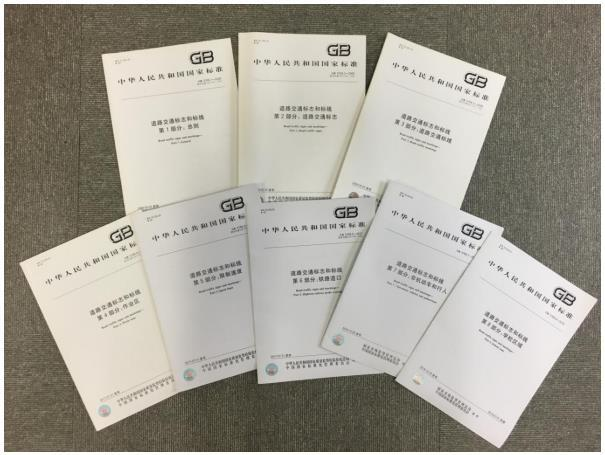
he standardization of road traffic signs and markings is constantly developing.
In September 2019, the Central Committee of the Communist Party of China and the State Council issued the "Outline for Building a Transportation Powerhouse," proposing that by the middle of this century, a transportation powerhouse that satisfies the people, provides strong guarantees, and ranks among the world's best will be fully built. The scale and quality of infrastructure, technological equipment, scientific and technological innovation capabilities, and the level of intelligence and green development will rank among the world's best; traffic safety levels, governance capabilities, civilization levels, international competitiveness, and influence will reach international levels; and the powerhouse will comprehensively serve and guarantee the construction of a modern socialist country, ensuring that the people enjoy excellent transportation services.
Road traffic signs and markings play a vital role in ensuring travel safety, regulating travel behavior, and maintaining the transportation system. In recent years, my country's road traffic safety coefficient has continuously improved, and road signs and markings have played a crucial role. For the road itself, reasonable traffic sign and marking settings can ensure driving efficiency and traffic capacity; for drivers, driving according to traffic signs and markings while adhering to traffic rules can reduce traffic accidents.
The state attaches great importance to road traffic safety and driving safety, continuously investing significant manpower and funds in improving traffic safety. Road traffic signs and markings standards are also constantly being revised and supplemented. With the widespread adoption and application of road traffic signs and markings in the future, in a smart and internet-connected world, these standards will continue to evolve to adapt to and meet societal needs, always adhering to the principles of putting people first and prioritizing life, and truly ensuring the safety of people's lives.
TATU Highway Group Markings, a subsidiary of TATU Highway Group, has focused on the road marking industry for 23 years. Its main products include hot-melt road marking paint, two-component road marking paint, and road marking equipment such as road marking machines. It holds a large market share both domestically and internationally, exporting to over 100 countries and regions.
