









TATU Highway Group, a manufacturer of road marking paint, produces road reflective glass beads, which are tiny glass beads formed by melting glass sand (waste glass) at high temperatures. Under a microscope, they appear spherical, colorless, and transparent, with a refractive index between 1.50 and 1.64, and a diameter generally between 75 and 1400 micrometers. Therefore, they are also called reflective glass microspheres. Due to their high sphericity, good hardness, strong wear resistance, and directional reflectivity, they are widely used in road reflective paint and other fields.
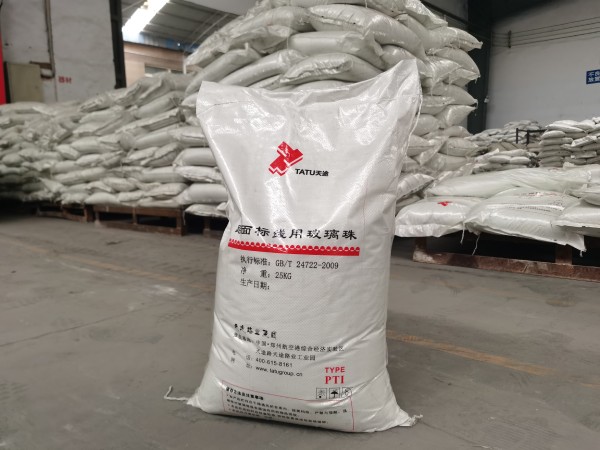
Road marking paint manufacturers explain that reflective glass microspheres, used as a reflective material in road markings (paint), improve the retroreflective properties of road marking paint, enhancing nighttime driving safety. This has been recognized by transportation departments worldwide. When a car travels at night, its headlights shine on road markings containing glass microspheres, causing the light to be reflected back parallel to the road surface, thus improving the driver's visibility and nighttime driving safety. Reflective glass microspheres have now become an irreplaceable reflective material in road safety products.
Reflective glass microspheres for roads are mainly used in both room-temperature and hot-melt road marking paints. One type is used as a premixed material to ensure long-term reflectivity throughout the marking's lifespan; the other type is applied to the surface during marking construction for immediate reflective effect. Road marking paint manufacturers remind users to pay attention to the sphericity of the glass beads when selecting them. A sphericity of at least 90% is required. Too many irregularly shaped glass beads will prevent directional reflection, affecting the reflective performance of the marking. However, an excessively high sphericity will result in overly strong reflected light, causing significant visual stimulation for drivers. Therefore, a small number of irregular microspheres are needed to create diffuse reflection, softening the reflected light.
