









After the markings are coated with hot-melt road marking paint and then covered with glass beads, they should dry quickly within a short period of time, regardless of the weather. Generally, thermosetting reflective road surface coatings have good quick-drying (hardening) characteristics, hardening rapidly in cold seasons and slowly in warm seasons. When the paint dries quickly, it can become distorted due to shrinkage, resulting in poor surface flow and poor fixation of the glass beads. When the coating dries slowly, not only do the scattered glass beads sink into the coating, reducing the reflective surface's effectiveness, but it also delays the opening of traffic, reducing road capacity. Therefore, the spraying temperature is usually lowered in the molten state to shorten the curing time.
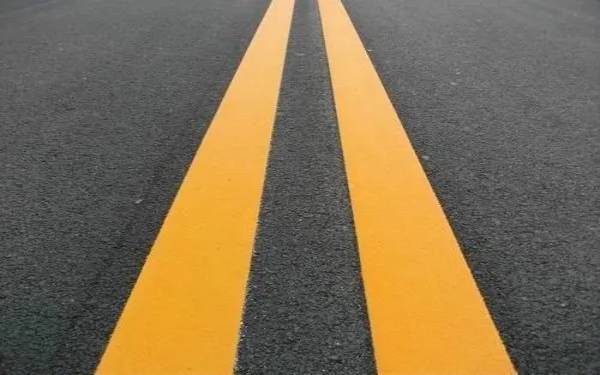
Features of hot melt road marking paint
Characteristics and application scope of hot melt road marking paint:
I. Adhesion and Bonding Principles of Hot-Melt Road Marking Paint:
The marking coating must have strong adhesion to the ground to prevent detachment or damage. Good adhesion to the ground prevents the coating from easily peeling off due to vehicle pressure, skidding, or braking; the ground will also not crack, bend, or peel off due to temperature changes. Hot-melt road marking paint is applied by heating thermosetting road marking paint to 180℃-220℃, melting the thermoplastic resin in the paint. The paint is then in a molten, fluid state and applied to the road using a road marking machine. Simultaneously, glass marbles are laid flat and allowed to dry at room temperature. When applied to concrete surfaces, the high-temperature molten coating bonds tightly to the concrete, resulting in poor adhesion. To improve the adhesion between the ground and the coating, a topcoat of the road marking paint needs to be applied earlier.
II. Visibility After Hot-Melt Road Marking Paint Application:
Whether day or night, hot-melt road marking paint should be bright, uniform, and clear, providing sufficient visual recognition distance. Daytime visibility depends on the quality of the pigment, which is relatively easy to manage. Nighttime visibility, or transmittance, depends primarily on the distribution quality of the glass beads. The distribution of glass beads should be uniform. Too many or too few beads will affect the reflective effect of the road markings. Secondly, temperature control during the road marking construction process is crucial. If the temperature is too high, the coating's fluidity will increase, meaning the dilution will decrease while penetration will increase, causing the glass beads to settle faster, even sinking into the molten coating, reducing the reflective effect. If the temperature is too low, the glass beads will not adhere firmly, ensuring only immediate reflective effect after construction; long-term reflective effect will be poor. Therefore, the glass beads are affected by coating temperature, thickness, and weather conditions, and the application time must be strictly controlled. Pay attention to the equipment used for distributing glass beads, and the effects of wind speed and frequency (wind from the air blower and passing vehicles) on the distribution of glass beads to prevent accumulation. Too much mixing will reduce the color during the day, causing unevenness, making it easier for dust to stick, and reducing visibility.
III. Abrasion Resistance of Hot-Melt Road Marking Paint After Application:
The forward movement of vehicles depends on the sliding friction between the wheels and the road surface. This sliding friction places high demands on road markings. In my country, real-time road conditions are complex, the road surface is hard, metal wheels move, and sand and gravel on the ground all pose significant requirements for the abrasion resistance of road markings.
IV. Aging Resistance of Hot-Melt Road Marking Paint After Application:
Thermosetting hot-melt road marking paint should possess good aging resistance. Considering the wide geographical distribution, varying climates (dry in the east and west, hot in the south and cold in the north), and diverse terrain, the raw material formulation of adjustable hot-melt road marking paint can be adapted to different climatic conditions, allowing for application in different seasons. Aging resistance should meet the estimated service life of the markings. If road markings are planned to be repainted every two years, ideally, most of the road marking coating should peel off after two years, or the ground surface should be easily cleaned to prevent old lines from affecting the guidance of traffic flow by new road markings, or to avoid spending excessive construction time on cleaning.
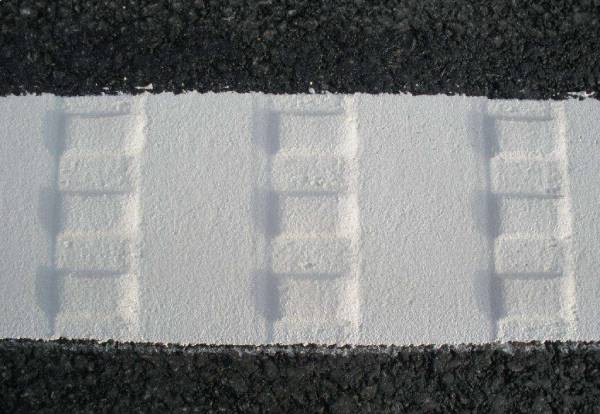
The principle of hot melt road marking paint
Based on over a decade of operational techniques and testing results, the application scope of thermosetting hot-melt road marking paint is summarized as follows: Suitable for axle lines, lane boundaries, edge lines, and guide lines where vehicle wheels frequently roll; sidewalks, intersections, underground parking lots, and roads without nighttime lighting; in terms of adhesion, asphalt roads perform best, followed by concrete surfaces. Not suitable for sandy surfaces, brick pavements, temporary surfaces, or surfaces requiring renovation every six months or more.
